Posted by Helen Brenna
Tina Wexler, my agent with International Creative Management, has graciously agreed to blog along with us for the day and answer any questions all you readers, writers, published and soon-to-be published, have to ask of an agent.
So here’s the scoop on the smartest agent in NYC.
Tina entered the publishing world shortly after finishing an MFA in poetry. She landed a job at the Ellen Levine Literary Agency assisting two literary agents and helping with foreign rights. Soon, she was cutting her teeth selling audio and first serial rights. Around the time ELLA merged with Trident Media, Tina moved to the Karpfinger Agency to work solely in foreign rights. Wanting to move into the domestic market, she took a position at International Creative Management and started building her list of clients. She’s brilliant, by the way. Took me on, didn’t she?
Helen: So what made you want to become an agent?
Tina: First off, let me thank you for inviting me to participate in this interview series.
As embarrassing as it is to admit, when I applied for the job at ELLA, I wasn’t exactly sure what a literary agency was, let alone what I would be doing there. All I knew was that it had to do with books and that was enough for me. And it’s been enough for me ever since.
Helen: Your welcome, Tina, for the invite, but I should be thanking you for visiting our blog today. Of course the fact that you agreed shouldn’t have surprised me. Word on the street is that you’re a “nice” agent. Even editors have commented on this obvious anomaly. Are you absolutely positive you picked the right career? What’s your favorite part about being an agent?
Tina: How dare they call me ‘nice’! I’m ruthless. I’m difficult. I’m…kidding. Actually, I’m terribly flattered. I never understood why agents got such a bum rap. Sure, we have to stick up for our clients, negotiate sticky situations, and talk about money (who likes talking about money?), but that doesn’t necessitate being mean. I guess it’s the difference between being a fly in the ointment and a thorn in someone’s side. I’ll take being the fly any day. (Wait, that didn’t come out right!)
My favorite part about my job is being able to work with authors, helping their dreams of being published come true and working to keep that dream alive for many, many years.
Helen: Do you think you’d ever like to write a book?
Tina: No way. Writing a book is hard! : )
Helen: Tell me about it!! Just out of curiosity, what are you reading now?
Tina: One of my friends from Maine (where I grew up) recommended I read Kelly Armstrong’s BITTEN. I’m nearing the end and amazed that it took me five years to discover this series. I’m a nut for vampires and now I’m starting to think I should add werewolves to that list. I’m also reading FAT CAMP by Deborah Blumenthal. It’s a YA novel that an editor gave me over lunch. And of course, there’s the stack of manuscripts under my desk that I’m always making my way through.
Helen: Michele, Anne, did you read that? Vampires and werewolves? What kind of book, Tina, do you wish you could find, but can’t?
Tina: Good question. I’d love to find a good near-future dystopia story. A YA version of THE HANDMAID’S TALE would make me jump for joy. On the adult side, I love paranormal (see above), adventure, mystery…I’ve been looking to get my hands on a good love story where one of the characters is a veterinarian. That’s pretty specific, I know, but I have a weakness for animals in fiction (so long as they can’t talk—in the Disney sense of “talk.”)
Helen: If you have to guess, name one trend in publishing you think is doomed to go belly-up.
Tina: Yikes! These questions are getting difficult. Hmm…Belly-up. One trend that’s certainly being challenged is the business model of publishing itself. No advance; higher royalties. I doubt most authors will be on board for this potential change, though I can understand why publishers are trying to find a way to stop the cycle of unearned advances. Supposedly if it’s done right, the author earns the same amount as she/he would with the current business model, though I don’t know how eager agents will be to jump on board this particular train either.
Helen: Ouch, I don’t think I wanted to hear that. Just to clarify further, when you say higher royalties, does that mean more dollars AS royalties, so the same total earn-out for a particular book or a higher royalty percentage? (Please say a higher royalty percentage !)
Tina: Yes, the royalty percentage would be higher. So instead of earning 10% on each hardcover copy sold, the author would earn…I don’t know. 25%? I’m guessing here. This business model--giving higher royalty percentages--is based on the author not receiving an advance. Is that clear? It's a trade off. Higher royalties but no $$$ up front?
Helen: Yeah, that makes sense, and I like the concept!! We should put you in charge of a major publishing house. Okay, so on to some nitty gritty stuff. On average how many submissions do you get every week?
Tina: I get about 10-20 query letters a week. Actual manuscripts, 2-5 (though not all of these are full manuscripts; some are proposals, the first 5 chapters, etc.) The number of manuscripts I receive directly relates to the number of queries and the quality of the queries. If 20 queries come in and none of them are good, the following week no manuscripts will come in. If, of the 20 all 20 are good, well, I better not make plans for the weekend!
Helen: What’s your ideal submission look, read, feel like?
Tina: My ideal query letter is one-page, clear, concise, friendly yet formal, written in a style that shows me a bit of what you’re like without being precious, realizes I’m busy busy busy and so gets right to the point, and comes with a/an SASE. As for manuscript submission: unbound, double-spaced, single-sided. When it’s right for me, it feels like diving into a clear lake, having tea with your best friend, listening to a secret. It feels like home and like nowhere you’ve even been before. It’s well crafted, it’s polished, and it moves along smoothly. It grips me right from the start and doesn’t let go. It makes me sit up and take notice. It sings.
Helen: Give us your pet peeve(s) relating to submissions.
Tina: My biggest pet peeve is when people send me their complete manuscript without first sending a query letter to gauge my interest. Imagine, if you will, that everyone did this. That’s twenty Jiffy mailers holding twenty boxes with twenty 200+ page manuscripts inside of them landing on my desk each week. Just the thought makes my eyes water. If I want to see a manuscript, I’ll ask to see it. It’s presumptuous to think you’re just speeding things along by cutting out the query process.
My other pet peeve is the mass e-query, especially when the email list isn’t even hidden. Mass e-queries make me want to pull my hair out; if you can’t take the time to personally address me in your query, I can’t take the time to read your query. (Are you sure I’m nice?)
I really could go on. People do loads of silly things. Some of them are honest mistakes. Others are just lazy. Sometimes I think it’s because people don’t take the industry seriously enough. It’s hard work getting published, finding an agent. If you aren’t willing to put the effort into writing a strong query letter, researching agents, proof reading both your query letter and your manuscript, revising your manuscript, etc. then you aren’t up to the task of being an author. Because the work doesn’t stop once you land that book deal. That’s only the beginning!
Helen: I can only imagine what you see in your mail. I’m sure it boggles the mind. I guess the message here is for us authors to be professional in our correspondence with agents, editors, other authors. Aside from that, if you were to give aspiring authors one word of advice, well, okay three words, but only three, what would they be?
Tina: Listen. Write. Repeat.
Helen: What do you think is the most important thing for an author to consider when looking for an agent?
Tina: I think it’s important to remember that you are going to be giving your agent your baby, your hard work, your name, your dream. You want someone who will put in the effort, who has the resources to do so, and who you trust and respect—and like. Your agent is going to be in your life for a long time (hopefully) and you want to make sure this is someone you want in your life.
Helen: What do you think is the most important thing to maintaining a good author/agent relationship?
Tina: I think it’s important for both parties to do their best to communicate their needs and wants. Discussing expectations can go a long way in ensuring a strong relationship.
Helen: Have you ever had a relationship with an author go sour?
Tina: Relationships with clients have ended for two reasons: 1) because I wasn’t able to sell the client’s work and he/she wanted to keep trying 2) because I wasn’t enthusiastic enough about the client’s next project and so didn’t think it wise to send it on submission but the client does. This is probably the most confusing for clients; I think the reasoning goes like this: You’re my agent. You submit my work. Submit this. But that’s only one part of my job. Another part is to advise my clients on what the best move is in the trajectory of their career while also protecting my reputation. If I submit a manuscript that I don’t believe in or that I think isn’t the author’s best work, I’m doing a disservice not only to that client but to my other clients.
Helen: What’s the biggest mistake you see, or hear about new authors making?
Tina: Assuming that the hard work is over once you’ve got the book deal. Forgetting that the publishing industry, though peopled by book lovers, is a business. Thinking your publisher is supposed to do all the work (I’m thinking specifically about book promotion here). Chasing the biggest advance instead of finding the right home for your work. Switching from agent to agent to agent (See previous). Trash-talking people in the business (Publishing, though far-reaching, is a relatively small world. If you say it, we hear it.)
Helen: Hey, you’re cheating! That was … five mistakes. Is there anything even established authors may not come back from?
Tina: Getting caught plagiarizing seems like the biggest mistake you can make. I’m not sure how you recover from that—Maybe in a tell-all memoir?
Helen: Yeah, we heard a lot about that a few months back. Someone will probably think of some way to profit from the situation. That brings to mind another questions. Should agents be involved in building an author’s career?
Tina: Absolutely. That’s what we’re here for. Of course, some authors don’t need or want career advice; others do. I say, no man’s an island. Wait, no John Donne said that (what was I saying about plagiarizing?), but I agree with him.
Helen: And here’s my last question. Do you believe in love at first sight?
Tina: Ah, yes. Why do you think I struggle every day not to adopt a third kitty?
Thank you again, Helen, for having me on the Riding with the Top Down blogspace. I welcome any and all questions, comments, etc. If anyone is interested in sending a query, please contact me either at
twexler@icmtalent.com or via post at ICM, 40 West 57th Street, NY, NY 10019.
Helen: Thank you, Tina, for coming along for a cyber-ride and answering all my tedious questions. I'm sure there are things you guys are dying to ask. Please go for it! Tina will be stopping by a couple times throughout the day to answer anything you’ve got up your sleeve.
And you can check out ICM’s website at:
http://www.icmtalent.com/


















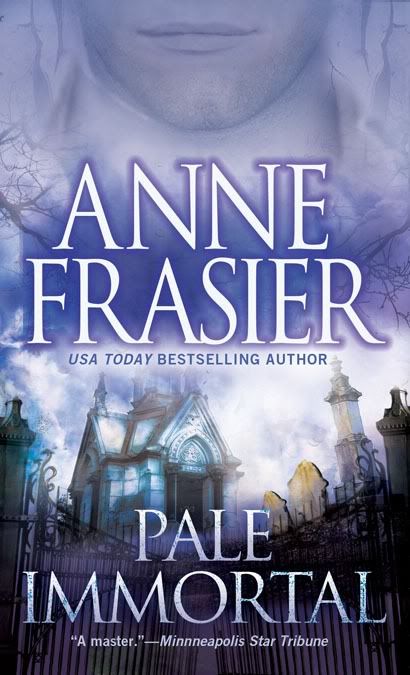 As of today, Anne Frasier's PALE IMMORTAL dwells among us.